
Shared Horizons: how are young people in the Western Balkans tackling disinformation?
In a region affected by a resurgence of nationalist rhetoric, the exploitation of identity narratives and conflicts over memory, disinformation and the manipulation of facts are gaining ground.
In the face of these trends, often fuelled by foreign powers, Component 3 of the Shared Horizons project sought to equip younger generations with the tools to better understand, verify and analyse information and the phenomena surrounding it. These issues also lie at the heart of the Western Balkans’ European future, where the consolidation of democratic and resilient societies is a key challenge.
A look back at the main initiatives undertaken.
The Shared Horizons project, funded by the Ministry for Europe and Foreign Affairs, was implemented by a consortium led by Expertise France, alongside CFI, ALDA, Play International, the Institut Français and Museum 90.
Led by CFI from January 2025 to August 2026, Component 3 builds on a long-standing commitment to the Balkans. It follows on from the Balkan Productions, Balkan Voices and Balkan Voices 2 projects, building on their achievements and placing the emphasis on younger generations.
In Albania, Bosnia and Herzegovina, Kosovo, Montenegro, North Macedonia and Serbia, CFI has thus brought together young people, journalists, experts and local organisations around a number of complementary initiatives. The project has supported independent local media organisations in producing content tailored to young audiences, launched the #YouthVsFake poster competition, deployed the Balkan News Truck and developed the transnational Cross-Border Dialogue programme.
These initiatives have helped to make media literacy, creativity and dialogue concrete tools for building resilience against hate speech and disinformation.
Producing engaging content to strengthen critical thinking among younger generations in the Balkans, and supporting the work of independent media and CSOs
Through a call for grants launched at the start of the project, 6 media organisations and civil society organisations in the Balkans received support to produce and disseminate innovative digital content, aimed in particular at strengthening young people’s critical thinking on social media.
In Albania, learning to fact-check with Super Pati
Faktoje has chosen to tap into the language and culture of younger generations with "Open Your Eyes, You Can Check Too", a manga series featuring Super Pati, a heroine who tracks down fake news. The videos present techniques for verifying images, videos, locations or AI-generated content in a fun and engaging way.
Shared on social media, the series has clocked up over 390,000 views.
- Example of content produced: Instagram
In Bosnia and Herzegovina, preventing rather than correcting disinformation
Zasto-Ne has made pre-bunking a key tool in the fight against ethno-nationalist disinformation and historical revisionism. Five campaigns addressed painful historical events such as the Markale massacres, the Srebrenica and Jasenovac genocides, through articles and short videos shared across several platforms.
The campaigns have clocked up over 1.2 million views, helping to raise young people’s awareness of revisionist narratives.
- Example of content produced: Facebook
In Kosovo, “Digital Sherlock” tackles disinformation
Action for Democratic Society (ADS), through its Hibrid.info platform, opted for a short-form video format with "Digital Sherlock: Combatting Disinformation Through Digital Education". A weekly monitoring of disinformation trends informed the production of 25 videos posted on TikTok, Instagram, Facebook and YouTube.
The result: nearly 2 million views, mainly among 18-34-year-olds, whilst strengthening the organisation’s digital production capabilities.
- Example of content produced: Instagram
In Montenegro, debunking disinformation surrounding the events in Cetinje
Organizacija Kod used the tragic events in Cetinje as a starting point to debunk disinformation and divisive media narratives. Research and discussions with 8 young people informed a position paper, followed by 5 episodes of the U Fokusu podcast, which were adapted into 11 educational videos and 10 posts.
The series as a whole exceeded 1.2 million views.
- Example of content produced: Youtube
In North Macedonia, deconstructing ethno-nationalist narratives
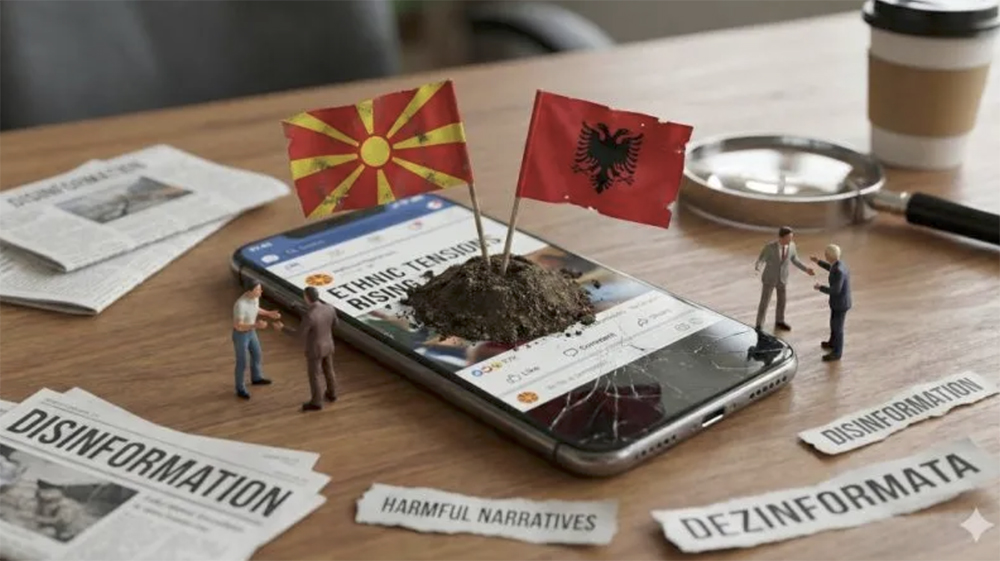
The Metamorphosis Foundation has been examining disinformation narratives based on ethnicity, particularly in the run-up to local elections. Its daily monitoring in Macedonian and Albanian identified 8 main types of ethno-nationalist narratives, which were then analysed in several articles and a dozen social media posts.
This content generated over 390,000 views.
- Example of content produced: Digital Trenches: How Ethnic Disinformation Kidnaps Reality Before Elections
In Serbia, responding swiftly to information manipulation
KRIK has stepped up its response to disinformation against a backdrop of particularly turbulent politics. Student protests, the tragedy in Novi Sad and the manipulation of political narratives were among the key drivers behind its production of short, responsive content.
The project generated over 2.8 million views on TikTok and Instagram and 2.4 million on Facebook, whilst the number of Instagram followers rose by 70 per cent.
- Example of content produced: Log in | TikTok
Projects that help embed new ways of working
Beyond the financial support provided to the organisations, these 6 projects have left a lasting impact on the beneficiary newsrooms, helping to develop their methods, skills and ability to reach new audiences. New practices have thus been integrated into the day-to-day operations of these media organisations: the practice of pre-bunking at Zasto-Ne, the monitoring of hate speech and disinformation at Metamorphosis, and the strengthening of fact-checking standards at ADS/Hibrid.info.
The projects have also led several media organisations to revamp their formats to adapt to the habits and expectations of young audiences. At KRIK, this shift has notably resulted in a 70 per cent increase in the number of Instagram followers.
Beyond the practical activities, the projects have helped to build up a valuable repository of reusable resources (educational content, podcasts, archives and models for counter-narratives) which continue to support the organisations’ activities even after funding has ended. Finally, they have helped to forge new partnerships and strengthen synergies between stakeholders, notably between Faktoje and the University of Tirana, but also between the various strands of Component 3 of the Shared Horizons project..
Results in figures:
- 6 media organisations supported
- 158 original pieces of content produced
- 10 million cumulative views
#YouthVsFake: creativity against disinformation
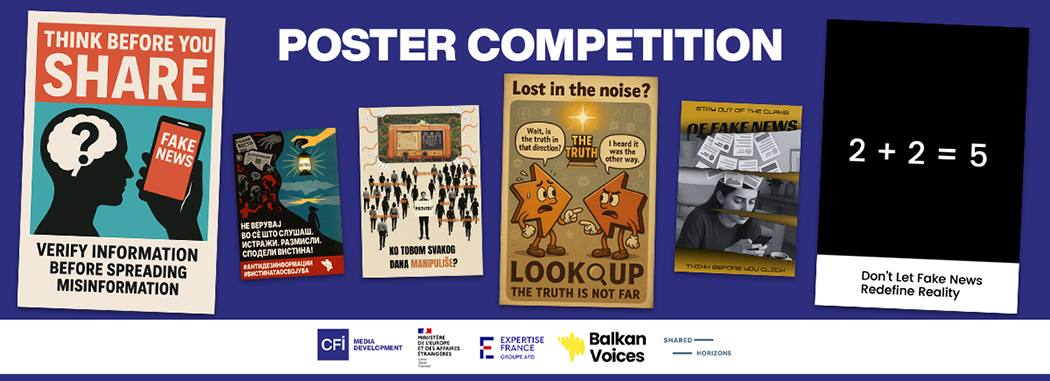
Younger generations are both prime targets of disinformation and key players in tackling it, particularly in the face of rising nationalist rhetoric. To mobilise them and encourage their creativity, CFI has launched the #YouthVsFake competition, which invites students under the age of 30 to design striking posters to raise awareness of the issues surrounding disinformation.
Nearly 170 young people from the 6 countries responded to the call.
An independent jury then selected the 18 winning posters, awarded 1st, 2nd and 3rd prizes. Each one explores disinformation from a different angle, offering original and relevant insights into its mechanisms, its consequences and the ways in which it can be tackled. Whether through boldness, humour or abstraction, the participants have turned an image into a valuable tool for critical thinking and civic engagement.
Giving young people a voice in the public sphere
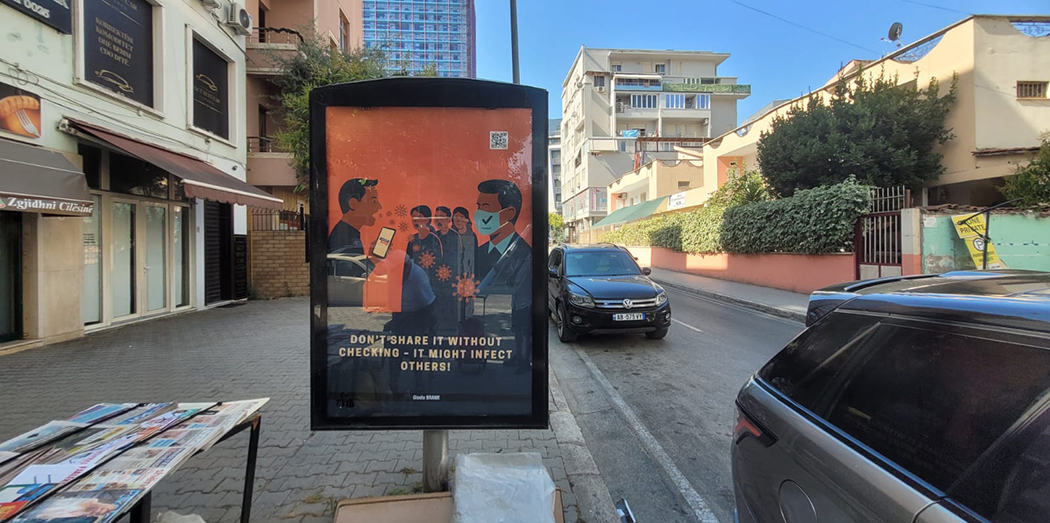
The messages devised by the young winners were then displayed in public spaces across the Balkans. The winning posters were put up in several capital cities and major towns in Albania, Bosnia and Herzegovina, Kosovo, North Macedonia and Montenegro, whilst a digital campaign was run in Serbia. Designed to reach audiences far beyond the competition entrants, the campaign focused on everyday locations: main roads, public transport, shopping centres, universities, cultural venues and other places particularly frequented by young people.
In Bosnia and Herzegovina, the posters were displayed in targeted locations across several towns and cities before being put up in busy public spaces in Sarajevo and Banja Luka.
The campaign also had a digital component: the QR codes featured on the posters generated nearly 70,000 clicks through to the Balkan Voices platform, whilst the digital component rolled out in Serbia reached nearly 4.2 million people.
Beyond the visibility figures, #YouthVsFake has, above all, transformed the young people’s creations into genuine tools for raising awareness. By giving their messages a platform in the public sphere and in digital media, the initiative has positioned them not merely as recipients of measures to combat disinformation, but as full participants in the response to manipulative and polarising discourse.
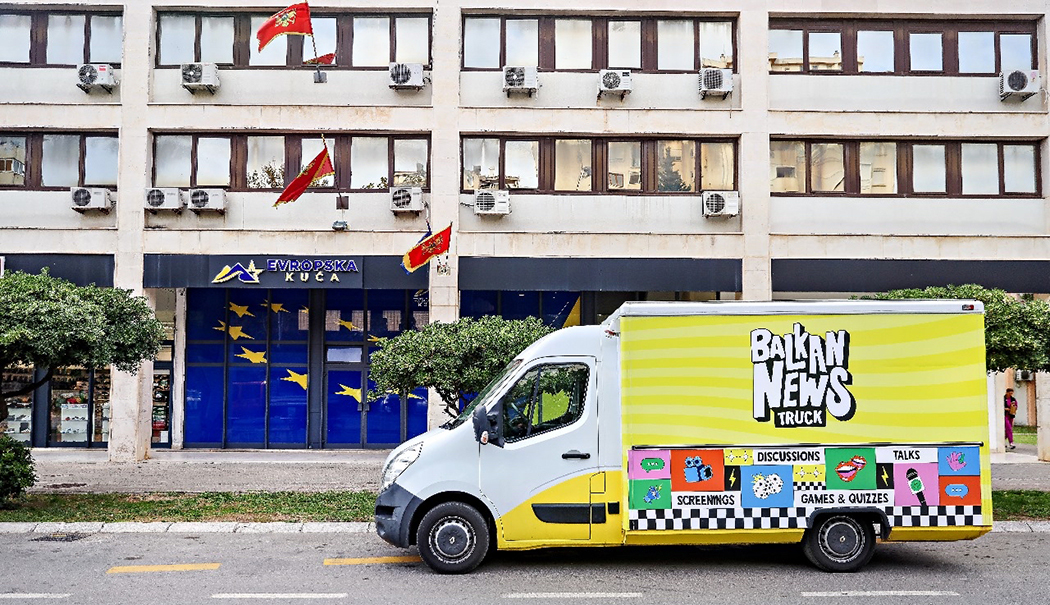
The Balkan News Truck: reaching out to communities to raise awareness of the dangers of disinformation
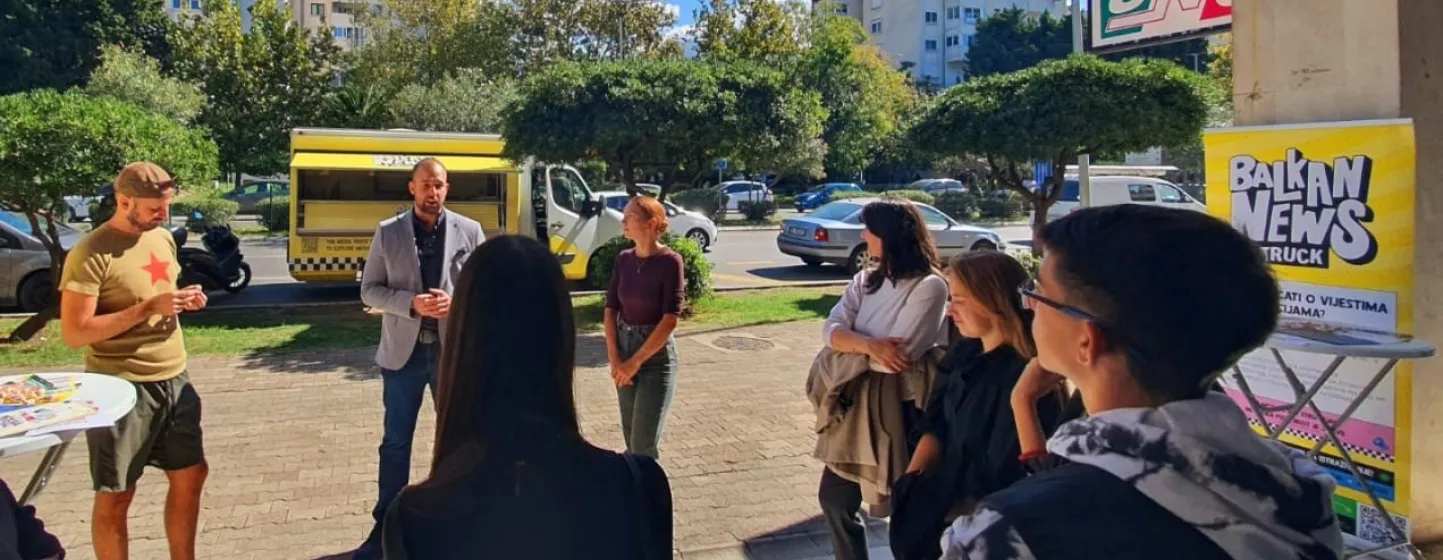
From September to November 2025, the Balkan News Truck (BNT) travelled the length and breadth of the Western Balkans to engage directly with young people. Designed as a mobile media literacy platform, the truck transformed public squares, schools and universities into spaces for dialogue and learning, tailoring its activities to the specific circumstances of each country.
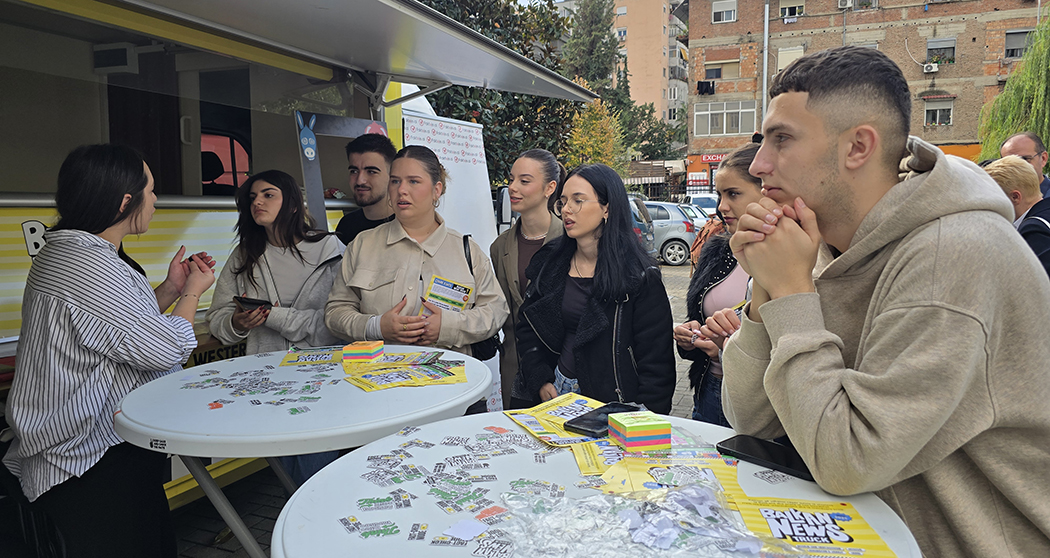
At each stop, screenings, fact-checking workshops, quizzes, role-plays and debates enabled participants to gain hands-on experience of the right approaches to verifying information and spotting manipulation, including that linked to AI and deep fakes. This fun and participatory approach fostered a high level of engagement among young people, whilst making sometimes complex mechanisms accessible.
Beyond its educational dimension, the “BNT” has also served as a unifying thread at regional level.
By travelling successively through the 6 countries, it has brought together communities facing similar challenges and facilitated the exchange, across borders, of experiences, practices and ideas relating to information. This cross-border dimension has given the project a collective scope, making the fight against disinformation a shared priority across the Western Balkans.
The travelling format also had a multiplier effect: in Montenegro, a secondary school student who had taken part in the activities went on to organise a similar activity for their classmates. In North Macedonia, discussions with secondary school pupils also enabled data to be collected on their information practices, which will be used to tailor Metamorphosis’s future media literacy initiatives.
With nearly 1,520 participants across the six countries, plus 51 speakers and 17 partner organisations involved, the BNT reached nearly 1,600 people. This pilot tour demonstrates that, to foster critical thinking, media literacy also benefits from moving beyond the classroom, reaching out to audiences and building bridges between societies in the region.
The Balkan News Truck in figures:
- 6 countries, 20 cities visited
- 1,520 participants, of whom over 55 per cent were women and 77 per cent were young people under 30
- 17 local partners
- 51 expert speakers and journalists
The Cross-Border Dialogue programme: crossing borders to tell each other’s stories
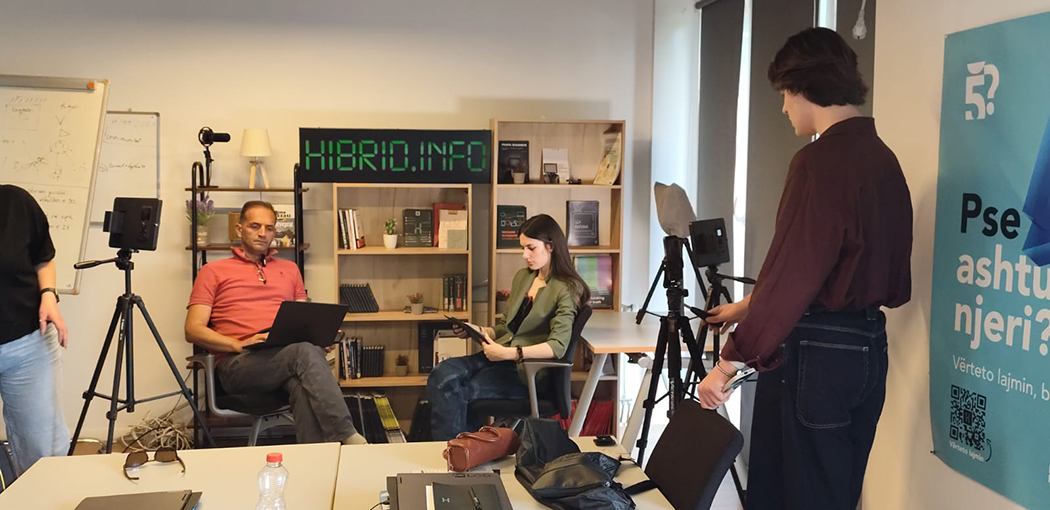
The aim of the Cross-Border Dialogue programme was to empower young people to produce their own stories. A regional call for applications led to the selection, recruitment and training of 12 young journalists and students in fact-checking, open-source intelligence (OSINT), mobile journalism and storytelling. They also formed transnational pairs, before travelling to another country in the region to carry out their reporting, accompanied by a local media mentor.
At the heart of the programme lay a simple idea: to cross a border to listen to, understand and recount the other’s perspective. By bringing together young professionals of different nationalities and exposing them to different stories, memories and social realities, the Cross-Border Dialogue programme sought to bring forth narratives based on experience and encounter, rather than on preconceptions and stereotypes.
The initiative resulted in the production and broadcast of 6 video reports exploring the mechanisms of historical disinformation and the challenges of European integration. Beyond the content produced, these experiences enabled the young participants to strengthen their journalistic skills and gain a fresh perspective on the realities of the region.
Broadcast by CFI and partner media organisations and promoted on social media, the productions also extended this dialogue to a wider audience, racking up nearly 950,000 views!
Six cross-border perspectives on the region:
• Ali Merdzanic & Mihaela Trenchevska - Religion and the memory of Yugoslavia, Belgrade
• Miloš Vlahovic & Jana Bojanic - Photography and the memory of the war, Pristina
• Savche Goscheva & Maylinda Bajrami - The memory of the siege of Sarajevo, Sarajevo
• Oriada Dajko & Laberion Nitaj - Young people and the European future of North Macedonia, Skopje
• Dilara Sollova - Culture and identities over a coffee, Monténégro
• Anastasija Duricanin - Young Albanians and the memory of communism, Tirana
The Cross-Border Dialogue programme has thus turned journalism into a tool for bringing people together and fostering mutual understanding, by giving a new generation the means to tell the story of the Balkans from within.
Whether it was a poster, an awareness-raising event in a public space or a video produced in a neighbouring country, these diverse initiatives all shared the same aim: to empower young people to question information, verify the facts and form their own perspectives. Through these activities, Shared Horizons sought to create spaces where young people from the Balkans were not merely an audience, but full participants in the dialogue on information, memory and the future of their region.