Less visible, more often attacked: in light of this observation, the impact of CFI’s work to strengthen women’s representation in the media
Women are vastly under-represented in the media(1), both in terms of editorial coverage and their presence in journalism and management positions. They are also the targets of threats, cyber-harassment and misinformation campaigns aimed at discrediting them or silencing them. It's a harsh assessment that undermines individual careers and the quality of democratic debate.
According to Kirsi Madi, Deputy Executive Director of UN Women, by September 2025: Media reflects reality – and is essential for democracy and a fair and equal world for all women and girls. But when women are missing, democracy is incomplete.
Female journalists are particularly exposed to violence: in a 2025 study, 75% of them said they had experienced online violence in the course of their work - the figure was 73% in 2020 -(2) , resulting in self-censorship, withdrawal from social media or even abandonment of the profession(3). Gendered misinformation is another growing threat: according to the AFP's fact-checkers, it uses gender stereotypes to attack the credibility of women journalists and politicians, undermining their legitimacy and participation in public life(4).
Empowering women journalists: a priority for CFI, with tangible results
CFI, the French media development agency, has been working to strengthen the position and safety of women in the media for many years. Promoting balanced representation, combating stereotypes, encouraging women's access to positions of responsibility and supporting the development of their skills are an integral part of its work.
In 2025, 800 women were supported or trained by CFI through medium - and long-term projects, representing nearly 50% of the media professionals CFI works with. In some of the agency's programmes, women make up more than half of the audience.
This is particularly the case for PAMT2 in Tunisia (57%), Media for One health in South-East Asia (66%), Balkan Voices 2, a project carried out in 6 Balkan countries with 75% women, and 75% for the Yak Vdoma project in Ukraine.
Evaluations and reviews of projects supported by CFI demonstrate the tangible impact of its work, in the short and medium term, in promoting greater participation and representation of women:
- The podcast "Laissons parler les gens", developed as part of the Kouman project in Côte d'Ivoire, recorded more than 17.5 million cumulative views, 24,000 hours of viewing between January 2025 and February 2026 and has 83,500 subscriptions across all platforms. By making the public figures affected by cyber-harassment and hate speech heard, the project is massively spreading awareness of online violence, particularly against women, and turning a social issue into a large-scale digital campaign.
- The Media Parity project in Botswana, Malawi, Mozambique, Lesotho and Zambia supports 22 media outlets and trains 88 journalists to strengthen gender equality in newsrooms. The project combines training, mentoring and harassment prevention to improve the representation of women in media content and foster their access to editorial responsibilities.
- Al Qadirat has enabled 25 young Palestinian journalists to enhance their skills, in particular to develop rigorous information checking practices in times of war, enabling them to become leading players in the fight against misinformation in the region.
- The Makanati project has helped to improve the representation and integration of women in the media in Iraq and Yemen, in particular by building the skills of women journalists (82% of the workforce) and supporting the production of dedicated content. This project has enabled several women to rise to management positions, and some have become trainers in their own right, demonstrating a virtuous cycle of knowledge/experience sharing.
- As part of the Afri’Kibaaru 2 project in Cameroon, Senegal, Guinea and Côte d'Ivoire, several dozen women have been trained in key matters and skills, including public speaking and information checking, thus rebalancing and strengthening and place of women in the media.
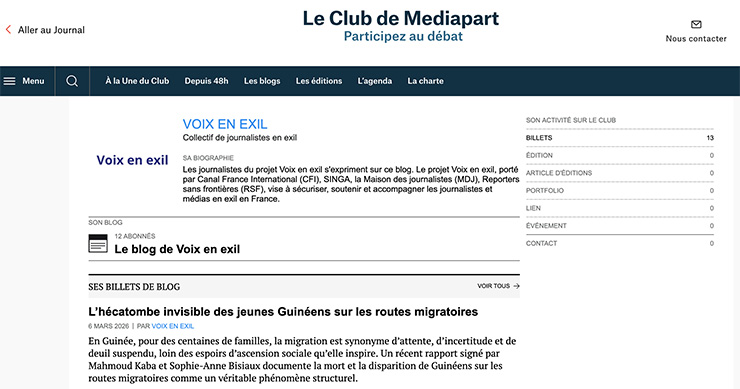
- The Voices in exile project has enabled 12 women journalists to continue to work and report the news from exile in France. Content and articles are available at Mediapart and Substack.
Supporting female journalists and women in management positions in the media is certainly a matter of equality, but also a prerequisite for ensuring pluralistic, inclusive, and quality information. When female journalists are prevented from working, are threatened, or rendered invisible, access to accurate and reliable information for all is undermined.
1. Women make up half of humanity, but receive only 26 per cent of media coverage, warns a new report from the Global Media Monitoring Project, UN Women, 4 September 2025
2. Global survey reveals rising violence against women journalists, UNESCO, le 11 December 2025
3. UNESCO
4. La Croix