
Budding environmental journalists
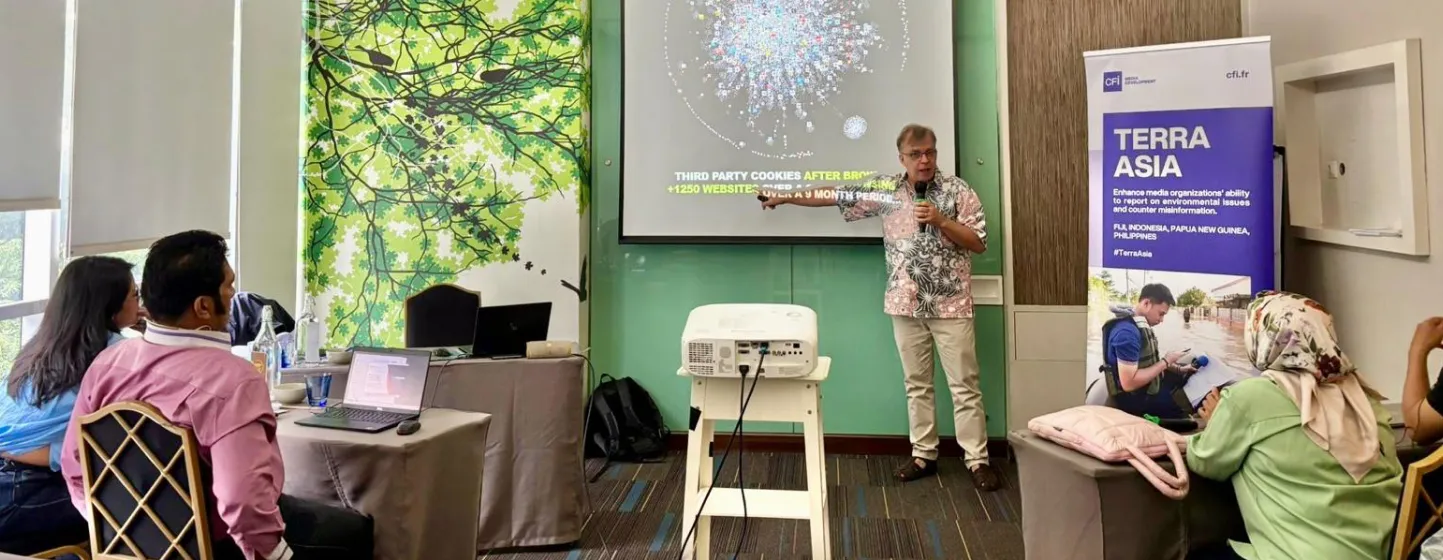
At the end of CFI's Terra Asia project, a number of students and trained young journalists are continuing to use the tools they have learnt to combat environmental misinformation. Illustrations in Indonesia.
Promising young talents against environmental disinformation. In Indonesia, the Terra Asia project relied on two key partners. Universitas Multimedia Nusantara (UMN): almost 10,000 students, including 239 enrolled in digital journalism. And Pusdiklat TVRI, the TVRI media training centre, which trains hundreds of journalists throughout Indonesia every year.
But how do you identify the standout candidates to take part in CFI's training courses in this country and online?
We selected them based on their roles and their ability to apply the knowledge they had acquired in their day-to-day work. We also ensured that the regions were properly represented in order to secure a wider impact within our network, explains Johan Setiawan, head of Pusdiklat TVRI.
It is also a selection process for the journalists of tomorrow: We targeted second-year students with an overall average of at least 3.00 (out of 4.00). Another criterion we applied was their willingness to undergo intensive training during their university holidays, with a level of commitment that we believe is essential for the next generation of investigative journalists. In the end, we recruited five students who met these rigorous requirements, said Dr Rismi Juliadi, lecturer at and aformer dean of the UMN Faculty of Communication.
Guaranteeing accuracy and veracity
Under these circumstances, it is easy to imagine the joy of the lucky few, who are delighted to be taking part in the Terra Asia sessions.
Today, we're no longer the only ones who can write articles and post them on social networks... That's why, as a future journalist, I also have to learn to check the information that's out there. Furthermore, given the concerning state of the environment in Indonesia, this information can help to raise awareness among the public and the authorities to look after environmental issues, said Natasha Suhendra (UMN).
Already a working journalist at TVRI, Citra Sandy Anastasia, 34, is of the same opinion: I've been passionate about these issues since I was at school. Fake news is a major global concern. It is therefore essential that we guarantee the accuracy and veracity of our reports.
The content of the sessions seems to have lived up to their expectations.
What interested me most? Learning to distinguish a fake video from a real one, as most of my work is visual, said Citra Sandy Anastasia about the online training. Having attended two in-person sessions, Natasha Suhendra highlighted the following: Fact-checking tools, geolocation of photos and videos, artificial intelligence tools and resources, verification websites, investigative techniques, mobile reporting...
Reporting that is essential for our democracy
At UMN, Dr Rismi Juliadi did observe changes in the participants who received a diploma: As well as mastering the technical tools of fact-checking and disinformation analysis, the students, who were previously just along for the ride, have become committed and enthusiastic stakeholders in the protection of information. By mastering the subtleties of environmental journalism, they will help make complex climate-related scientific concepts accessible to the general public. Accurate, contextualised reporting that enables citizens to make informed decisions, thereby promoting a more resilient and environmentally responsible society, is essential to our democracy.
Johan Setiawan also envisioned the future impact this will ultimately have on the public: Our journalists are now better prepared to deal with complex subjects and combat misinformation, which will ultimately benefit our audience. We have already observed better fact-checking practices and a more critical approach to information sources. These lessons also enrich our training programme at Pusdiklat TVRI.
To sustain their rapid growth, the promising young environmental journalists and their tutors are looking forward to new projects with new apprenticeships: data journalism, mobile journalism (MoJo) and short documentaries, investigative techniques, advanced fact-checking methods, communication for sustainable development, collaborations between academia and industry, etc.
Analysis by Emmanuel de Solère Stintzy (Journalistes Médiateurs)